

BT VoIP is a modern phone service that works over an internet connection instead of a traditional landline. It uses Voice over Internet Protocol (VoIP) technology to make and receive calls through broadband, offering clear sound quality and flexible communication options. BT calls this service “Digital Voice” for home users and “BT Cloud Voice” for businesses, both designed to support the UK’s move away from the old analogue network.
 As the country prepares for the switch-off of the Public Switched Telephone Network (PSTN) by 2027, BT VoIP provides a straightforward way to stay connected. It keeps calling simple while adding features that make communication more efficient, whether for families or workplaces.
This article explores how BT VoIP works, what equipment it needs, and why many homes and businesses are already switching. It also looks at its key benefits, reliability, and how it compares to other VoIP options available today.
Understanding BT VOIP and Digital Voice
 BT uses Voice over Internet Protocol (VoIP) technology to deliver phone calls through broadband instead of the traditional copper network. This change supports clearer calls, modern features, and prepares homes and businesses for the UK’s digital switchover from analogue to digital landlines.

What Is BT VOIP?
BT VoIP, known as BT Digital Voice, is a broadband-based phone service that replaces the old Public Switched Telephone Network (PSTN). Instead of using copper wires, it sends voice data over the internet.
It allows users to make and receive calls using their existing home phone, provided it connects to a BT Smart Hub 2 or a compatible adapter. Over 99% of current handsets work with the service, making the transition simple for most households.
BT VoIP offers features such as voicemail, call blocking, and caller display. Because calls travel over the internet, sound quality is often clearer and more stable than on older analogue lines.
| Feature | BT Digital Voice Benefit |
|---|---|
| Connection type | Broadband (VoIP) |
| Equipment | Smart Hub 2 or adapter |
| Handset compatibility | Over 99% of existing phones |
| Call quality | High-definition audio |
How Digital Voice Replaces Traditional Landlines
BT is phasing out the analogue landline network (PSTN) by 2027. All customers will move to Digital Voice, which uses internet-based calling.
This change is part of the UK’s digital switchover, where phone services shift from copper to fibre and broadband networks. The move supports faster, more reliable communication and reduces maintenance on ageing infrastructure.
Users connect their home phone directly to their broadband router. During power cuts, they may need a backup power supply for their router to keep the phone working.
Digital Voice keeps the same phone number and calling experience but runs on modern technology that supports future digital services.
How Voice over Internet Protocol Works
Voice over Internet Protocol (VoIP) converts voice signals into small digital data packets. These packets travel through the internet to the recipient, where they are turned back into sound.
This process happens almost instantly, allowing natural, real-time conversations. Unlike traditional lines, VoIP does not rely on physical exchanges but on broadband connections and network servers.
BT’s system uses secure servers and encryption to protect call data. Call quality depends on internet speed and stability, so a strong broadband connection is essential.
By using VoIP, BT can integrate phone, broadband, and smart home services under one digital platform, improving efficiency and reducing costs for users.
Key Features and Benefits of BT VOIP

 BT’s VoIP solutions combine cost efficiency, reliable call performance, and flexible scaling options suited for small and large organisations. They give businesses the tools to manage calls, maintain continuity, and support remote or hybrid teams using an internet-based phone system.
Lower Costs and Flexible Packages
BT VoIP reduces communication expenses by routing calls over the internet instead of traditional phone lines. This helps businesses avoid high line rental fees and long-distance charges.
Companies can choose from tiered call packages that match their usage needs. For example, smaller teams may prefer a basic plan with standard features, while larger enterprises can use advanced packages with added tools like call recording or voicemail-to-email.
BT also offers pay-as-you-go and unlimited call options, giving businesses flexibility to control spending. Because the service works through existing broadband, there is no need for separate infrastructure, which further lowers setup costs.
| Feature | Benefit |
|---|---|
| Internet-based calls | No need for traditional phone lines |
| Custom call packages | Pay only for what is needed |
| Bundled features | Voicemail, call blocking, and recording included |
Call Quality and Advanced Calling Features
BT VoIP provides HD voice quality, which ensures clear and consistent sound during calls. The system uses managed networks and prioritises voice traffic to reduce lag and dropped connections.
Users gain access to advanced features such as voicemail, call forwarding, call blocking, and call recording. These tools help teams handle high call volumes and maintain professional communication standards.
Integration with video conferencing and instant messaging allows employees to switch between communication methods without needing separate systems. This unified approach supports collaboration and reduces downtime caused by switching platforms.
Scalability and Business Continuity
BT’s VoIP services scale easily as organisations grow. New users or devices can be added through the online portal without requiring new hardware installations. This makes it simple to expand or adjust capacity during busy periods.
Because the system operates in the cloud, calls can be rerouted to mobiles or other locations during outages. This supports business continuity, ensuring operations continue even if the main office loses connectivity.
Remote staff can access the same VoIP features as office-based employees, helping maintain consistent communication across all sites.
BT VOIP Equipment and Setup
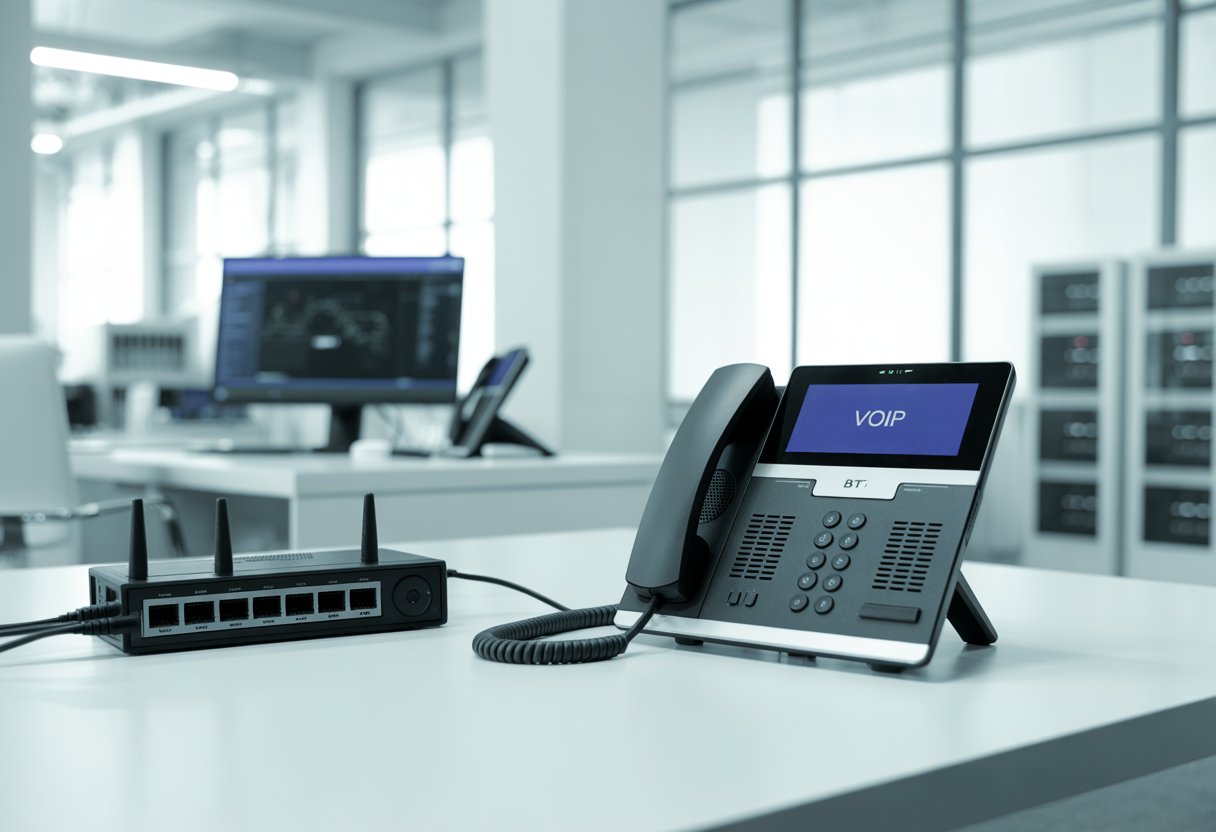
BT’s VoIP service, known as Digital Voice, uses broadband to deliver phone calls through the internet instead of traditional copper lines. It requires compatible equipment such as a BT Smart Hub 2, suitable handsets, and sometimes a Digital Voice Adapter to connect phones in different parts of the home or office.
Required Broadband and Routers
BT VoIP runs on BT Broadband, which must be stable and fast enough to handle voice traffic. A fibre broadband connection provides the best performance for clear, reliable calls.
The BT Smart Hub 2 is the main router used for Digital Voice. It manages both the internet and phone connections through one device. The hub includes a green phone port for wired handsets and supports wireless pairing with BT’s Digital Voice phones.
Users setting up VoIP with other broadband providers must ensure their router supports VoIP features, such as Quality of Service (QoS), to prioritise voice data. However, BT’s Smart Hub 2 remains the recommended option for automatic configuration and full compatibility with BT’s network.
VOIP Phones, Handsets, and Adaptors
BT offers several compatible Digital Home Phones, including the Essential Digital Home Phone and the Advanced Digital Home Phone. These handsets connect wirelessly to the Smart Hub 2 and include features such as caller display, call blocking, and voicemail notifications.
For those using older or third-party phones, a Digital Voice Adapter (or adaptor) allows standard handsets to connect wirelessly to the hub. This is helpful when the phone needs to be placed away from the router.
If a customer uses a multi-handset system, the main base unit connects to the Smart Hub 2, while secondary handsets work as usual. Phones made before 2015 may need a microfilter to ensure they ring correctly when used with the adapter.
Setting Up Digital Voice at Home or Business
Once BT activates the service, setup is simple. Users should wait for a steady blue light on the Smart Hub 2 before pairing any handsets.
To connect a Digital Voice handset, plug in the charger, switch it on, and press the WPS button on the hub for two seconds. The handset will register automatically. Wired phones can plug directly into the green phone port on the hub.
A Digital Voice Adapter can be placed anywhere with a power socket, allowing flexible phone placement around the home or office. Businesses using multiple VoIP phones can follow similar steps, ensuring each handset or adapter connects securely to the Smart Hub 2 for consistent call quality.
BT VoIP for Businesses and Remote Work
BT VoIP provides digital voice solutions that help organisations manage communication across offices and remote locations. It supports flexible working, integrates with modern collaboration tools, and uses reliable BT Business fibre broadband to maintain clear and consistent call quality.
Cloud Voice and VoIP Phone Systems
BT offers several VoIP options, including BT Cloud Voice and Cloud Phone, designed for businesses of different sizes. These systems use the internet instead of traditional phone lines, allowing calls to run through BT Business fibre broadband for stable performance.
Smaller teams can use Cloud Phone, which connects easily to existing sockets and supports up to nine users. Larger businesses often choose Cloud Voice, which provides advanced features such as call management, voicemail-to-email, and user extensions that scale as the company grows.
A key advantage is flexibility. Businesses can add or remove users without major hardware changes. Numbers remain active even if the company relocates, since VoIP numbers are not tied to local exchanges. This makes BT VoIP systems cost-effective and easier to manage than traditional phone lines.
Remote and Hybrid Working Capabilities
BT VoIP supports remote and hybrid work by allowing employees to make and receive calls from any location with an internet connection. Staff can use IP phones, laptops, or mobile apps to stay connected to the same phone system as the office.
Features such as call forwarding, presence indicators, and shared directories help teams stay reachable. This setup ensures consistent communication between office-based and remote staff without the need for separate systems.
BT Business fibre broadband provides the speed and reliability needed for clear voice quality and minimal delay. For companies with flexible work policies, this means employees can switch between home and office without losing access to essential communication tools.
Video Conferencing and Integration
BT Cloud Voice integrates video conferencing and messaging into a single platform. Users can join meetings, share screens, and chat through one interface, reducing the need for multiple applications.
This integration supports seamless collaboration. Teams can move from a phone call to a video meeting without switching devices or software. The system also connects with common business tools, such as calendars and contact directories.
By combining calling, video, and messaging, BT VoIP helps businesses maintain efficient communication workflows. It enables teams to work together smoothly, whether they are in the same building or spread across different locations.
Security, Reliability, and Support
BT’s VoIP service focuses on keeping business communications secure, stable, and well-supported. It uses modern encryption, network monitoring, and backup systems to reduce risks from cyber threats, power cuts, and service interruptions.
Data Protection and Network Security
BT VoIP uses encryption and secure data centres to protect voice traffic and customer information. Calls are transmitted using Secure Real-time Transport Protocol (SRTP) and Transport Layer Security (TLS), which help prevent eavesdropping and data leaks.
Its cloud-based infrastructure includes firewalls, intrusion detection systems, and regular network tests to identify weaknesses. BT also offers Call Protect, which blocks unwanted or scam calls before they reach users.
BT’s systems are monitored by a team of over 3,000 security experts who provide 24/7 protection. These measures help businesses maintain compliance and limit the chance of service disruption or data breaches.
| Feature | Purpose |
|---|---|
| Encryption (SRTP/TLS) | Protects call data in transit |
| Call Protect | Blocks nuisance and scam calls |
| 24/7 Monitoring | Detects and responds to threats quickly |
Power Cuts and Battery Backup
VoIP services depend on power and internet connectivity. During a power cut, calls cannot be made unless backup power is available. BT recommends using a battery backup unit (BBU) to keep essential devices running.
For customers who rely on telecare or healthcare alarms, maintaining power to communication equipment is critical. BT provides guidance and optional backup solutions to ensure these services remain active during outages.
A typical BBU can supply power for several hours, depending on usage. It supports both the Smart Hub 2 router and connected VoIP handsets. Businesses and households can also use uninterruptible power supplies (UPS) for extended coverage.
Customer Support and Service Reliability
BT provides 24/7 customer support to help with technical issues, service setup, or fault resolution. Users can contact support by phone or online, and many problems are resolved remotely.
The VoIP platform is hosted in secure UK data centres with high uptime targets. These centres use redundant connections and automated failover systems to keep calls running smoothly.
BT also performs regular maintenance and updates to improve reliability. This combination of proactive monitoring and responsive support helps ensure consistent service quality for both home and business users.
Switching to VOIP and Keeping Your Number
When switching from BT to another VoIP provider, users can usually keep their existing BT phone number. The new provider handles the porting process, which normally takes a few working days. During this time, service interruption is minimal if broadband remains active.
To switch, customers need a stable internet connection and a compatible phone or VoIP adapter. Most UK providers, including Plusnet, Phonely, and Voipfone, allow users to bring their own equipment. BT’s Digital Voice handsets, however, may not work with third-party systems without an adapter.
People moving from a traditional landline to VoIP often notice clearer call quality and lower monthly costs. The process is straightforward, but users should confirm contract terms before cancelling BT services.
Customisation and Additional Features
BT VoIP offers standard features such as voicemail-to-email, call forwarding, and conference calling. Competing providers often extend these with custom dashboards, mobile apps, and integrations with business tools like calendars or customer databases.
For example, Voipfone allows users to manage extensions and call routing online, while Vonage includes video meetings and messaging. These features make VoIP more flexible for remote or hybrid teams.
BT focuses on reliability and support rather than deep customisation. However, its Cloud Voice platform for businesses includes scalable feature packs that grow with user needs. Those wanting advanced automation or app integration may find third-party providers more adaptable.
Frequently Asked Questions
BT’s VoIP service uses broadband to deliver clear, reliable voice calls without relying on the old copper network. It offers flexible setup options, lower running costs, and compatibility with many existing communication tools used by homes and businesses.
How does a VoIP telephone system function?
A VoIP system converts voice into digital signals that travel over the internet instead of traditional phone lines. The BT Smart Hub 2 or a compatible adaptor connects the phone to broadband, allowing calls to be made and received through the same network used for online access.
What are the primary advantages of using a VoIP service over traditional telephony?
VoIP provides features such as voicemail, call diversion, and spam call blocking at no extra cost. It also supports multiple calls at once and offers clearer audio quality when used with digital handsets. Users can keep their existing numbers and enjoy more flexible call management.
Can VoIP services be integrated with existing business communication systems?
Yes. BT’s VoIP solutions can connect with common business software and unified communication platforms. This allows teams to manage calls, video meetings, and messages through one system, improving efficiency without replacing existing IT infrastructure.
What are the potential cost savings when switching to a VoIP phone system?
Because VoIP uses broadband rather than separate phone lines, there are fewer maintenance and line rental costs. Calls between VoIP users are often free, and international or long-distance rates are usually lower than on traditional networks.
How does voice quality compare between VoIP and traditional landline services?
When supported by a stable broadband connection, VoIP calls often sound clearer than analogue ones. BT’s Digital Voice service supports HD calling on compatible handsets, reducing background noise and improving speech clarity. Poor internet connections, however, can affect call quality.
What measures are in place to ensure the security of VoIP calls?
BT uses encryption and network monitoring to protect call data from unauthorised access. Firewalls, secure login credentials, and regular software updates help keep systems safe. Users are also advised to avoid sharing personal information during suspicious calls to reduce fraud risks.
